Visual Problem-Solving & Storytelling
Every commission presents a distinct challenge. My role is to understand the story, find the visual idea at its center, and tell it in a way that lasts.
Case Study One
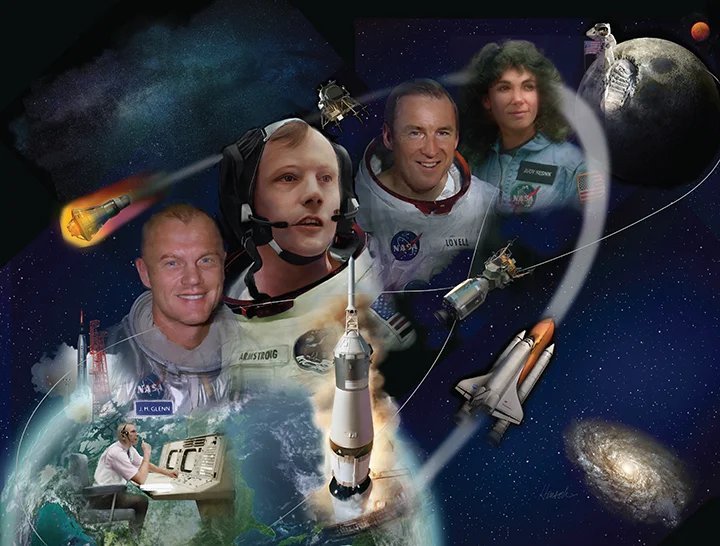
Ohioans in Space, 12 feet wide by 9 feet, Ohio Statehouse Rotunda
The Challenge
The State of Ohio, through the Ohio Arts Council, sought a major painting honoring Ohio's extraordinary place in America's space program. The challenge was to bring several legendary figures, missions, machines, and historical moments together in one coherent visual story.
The Original Concept
I developed three concepts. The strongest organized the story around the people, places, missions, and equipment of the early space program. Rather than creating a simple group portrait, the composition was designed so viewers could immediately understand the larger story.
The Collaborative Process
Working through Charlie Moses of the Ohio Arts Council, the concept was shared with the astronauts' families. Their reactions helped shape important decisions, including how individual astronauts and difficult historical events would be represented.
The Symbolism
The painting traces a journey from Earth toward the Moon. Gene Kranz represents the enormous human effort on the ground, while the astronauts rise through the composition in historical sequence — John Glenn, Neil Armstrong, Jim Lovell, and Judith Resnik — creating a visual trajectory through the formative years of America's space adventure.
The Finished Solution
The result was a monumental 12-foot-wide by 9-foot painting that now hangs in the Rotunda of the Ohio Statehouse. It is one of the select major paintings occupying that ceremonial space and serves as a permanent visual record of Ohio's contribution to space exploration.
Case Study Two
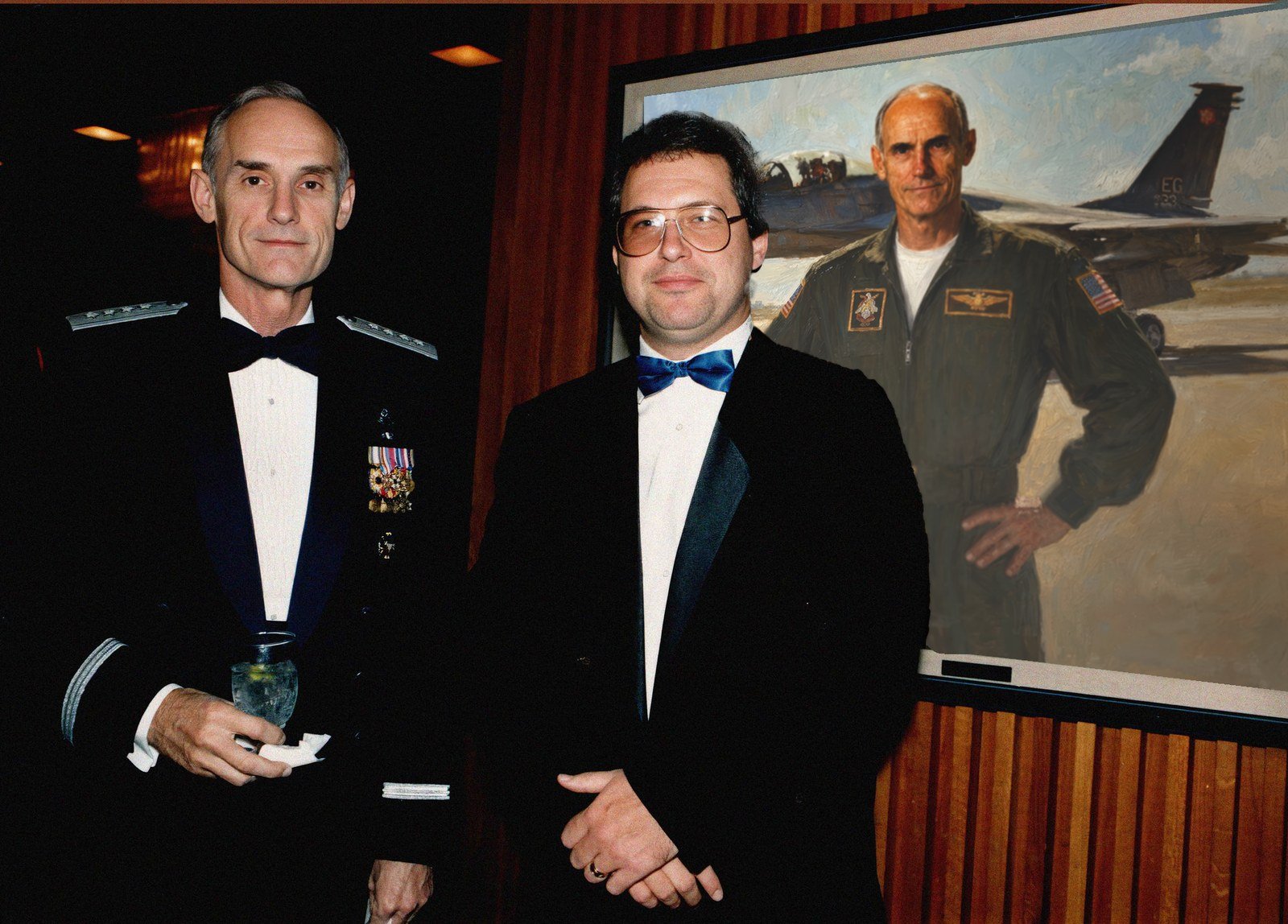
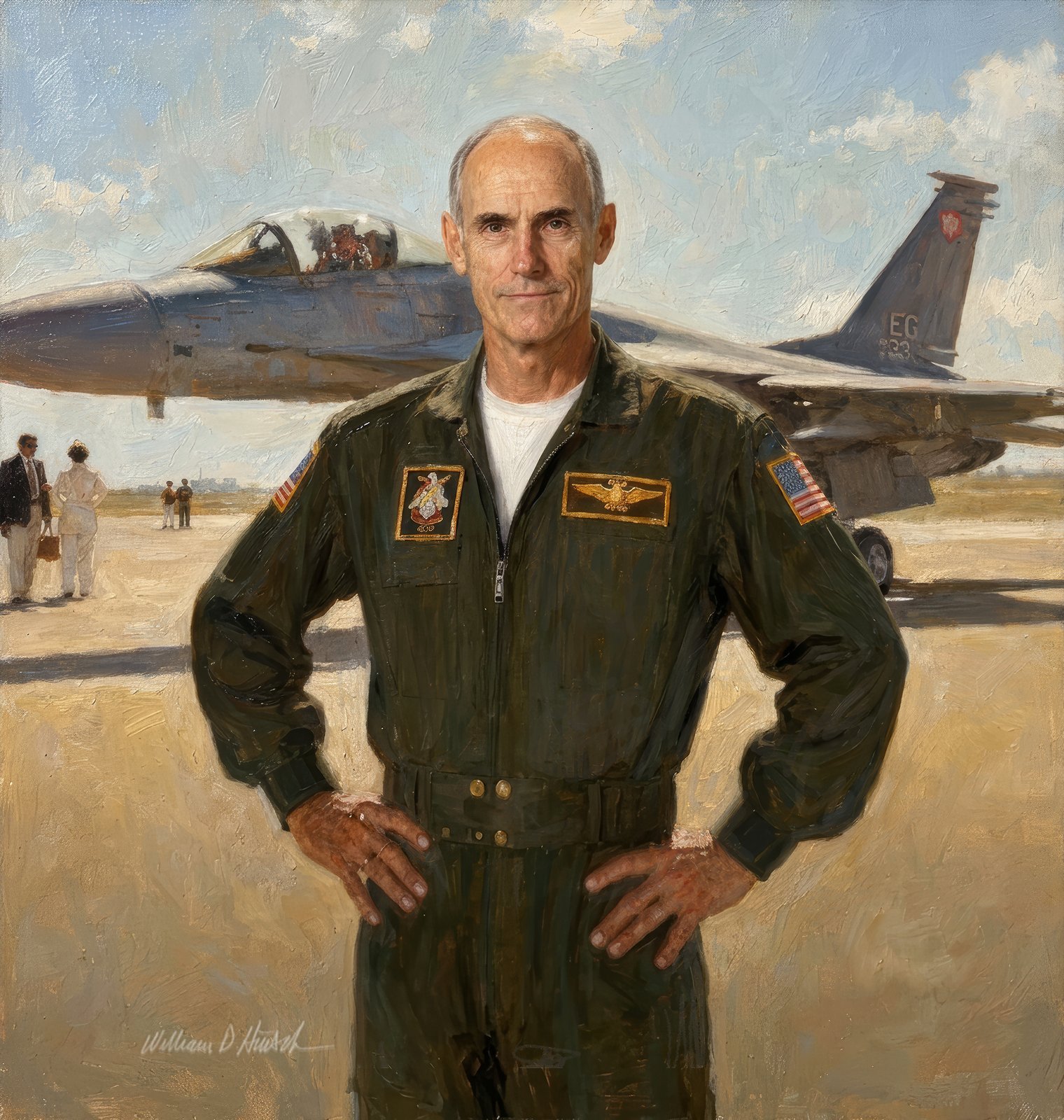
General Merrill McPeak, donated to the United States Air Force through the Air Force Art Program
The Challenge
The challenge was to portray the Chief of Staff of the United States Air Force as a complex and formidable leader, while avoiding the predictable formal portrait of a senior officer posed behind a podium or defined primarily by rank and medals.
The Original Concept
From the beginning, I wanted to place General McPeak in the environment that best expressed who he was: on the flight line. The concept evolved from a tighter composition into a broader view showing him on the tarmac with an F-15, giving the setting and aircraft a more meaningful role in the portrait.
The Collaborative Process
A central collaborator was my close friend Harley Copic, one of the leading aviation artists of his generation. We regularly traded artistic ideas, and his judgment helped me think through both the concept and execution of the painting.
The Symbolism
The symbolism comes from placing the man in his milieu. The flight line and aircraft communicate the fighter pilot beneath the four-star uniform and present leadership through experience, action, and service rather than ceremony.
The Finished Solution
The completed painting was donated to the United States Air Force through the Air Force Art Program and formally presented to General McPeak at a major presentation event.
William and General McPeak at the painting's formal presentation
Case Study Three
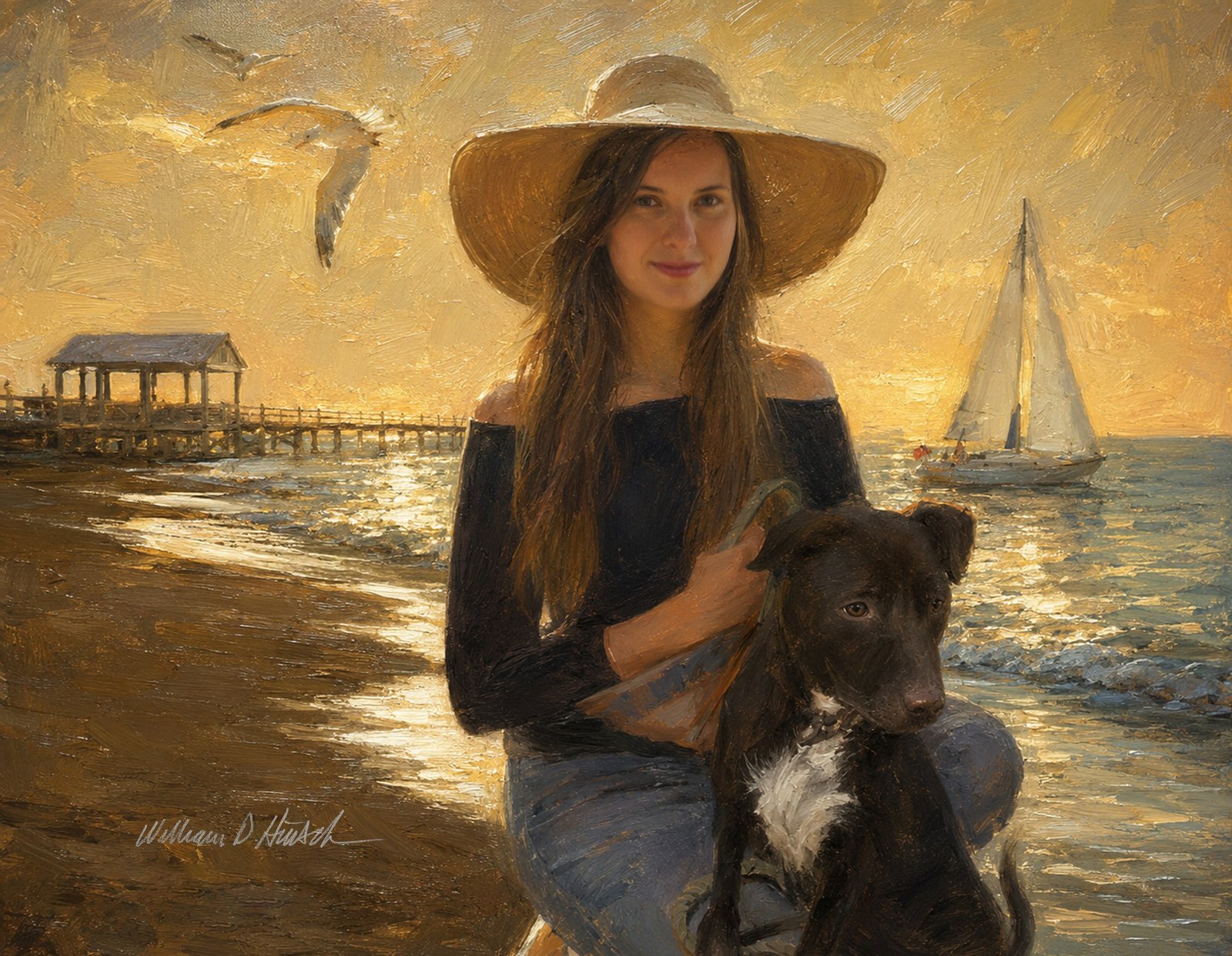
Chloe, painted as a gift from her best friend to her parents
The Challenge
A young woman's best friend commissioned a portrait of Chloe, who had died by suicide, as a gift for Chloe's parents. The challenge was to create something deeply personal without allowing the tragedy of her death to overwhelm the life being remembered.
The Original Concept
I had very limited photographic reference, so the portrait had to be built through conversation and imagination. An interview with her best friend helped me understand who Chloe was, what she loved, and how she should be remembered. The goal became not merely to reproduce a photograph, but to humanize her and show her in her best light.
The Collaborative Process
The collaboration was primarily with Chloe's best friend, whose memories provided the emotional and biographical foundation for the painting.
The Symbolism
Chloe is shown informally on a North Carolina beach she loved, with her dog beside her. The beach, the dog, her relaxed clothing, warm evening light, distant sailboat, and open sky create an image centered on the things that mattered to her and the person she was.
The Finished Solution
The finished painting became a quiet, dignified memorial — an attempt to convey through paint a truth about Chloe that a single photograph could not fully contain, and to give her parents an image of their daughter meant to be lived with and treasured.
Case Study Four
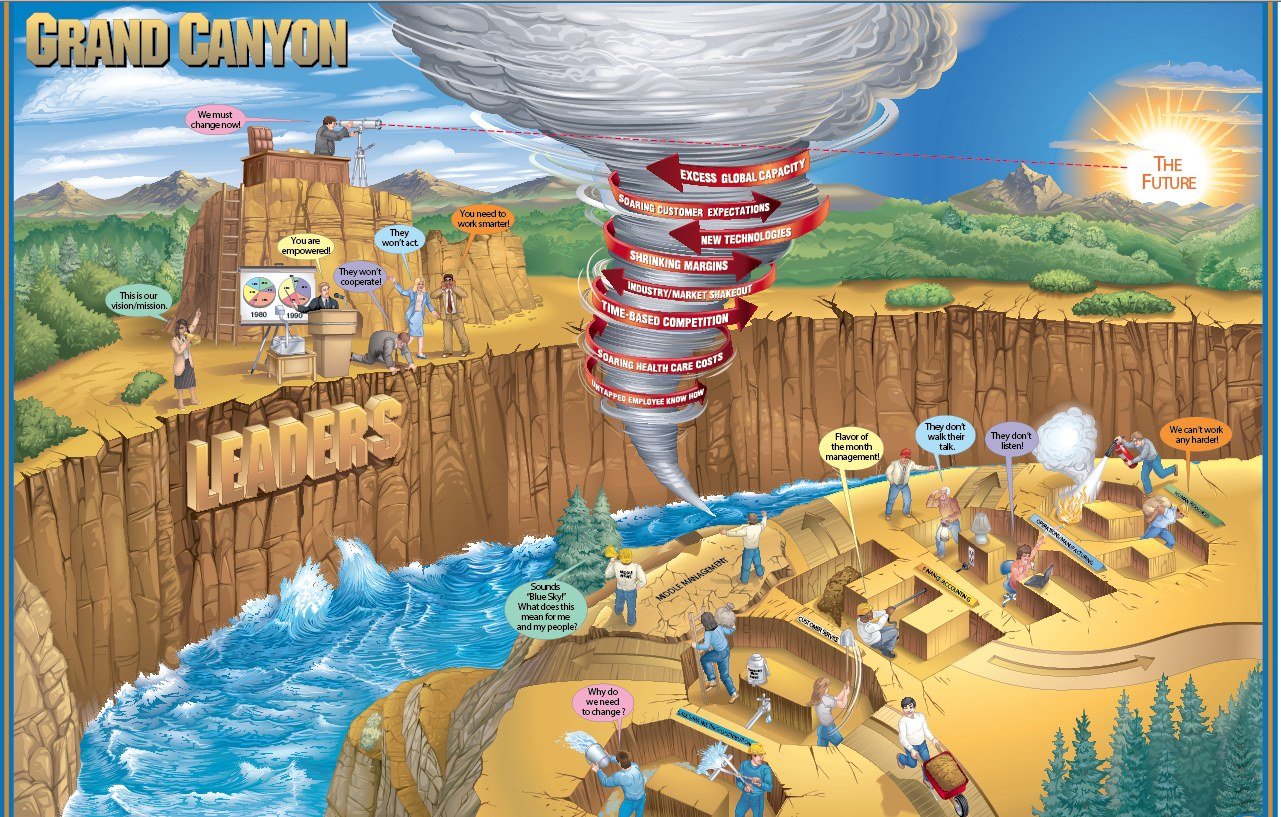
The Grand Canyon Learning Map, 1992 — still referenced today across the business visualization genre it helped originate
The Challenge
In 1992, I helped found Root Learning with Randy Root in Perrysburg, Ohio. The work opened an entirely new professional direction for me: taking thousands of pages of business strategy, research, and organizational information and distilling that complexity into a single visual story.
The Original Concept
The image was never intended to stand alone. It served a learning process in which small groups gathered around a visual, explored a company's strategy, and learned through a guided conversation. The visual and the dialogue worked together.
The Collaborative Process
The process was inherently collaborative and iterative. I developed the visual language, methodology, working process, and approach to revision, then eventually built and led a staff capable of carrying that process forward. What began with me doing nearly everything evolved into a scalable creative discipline.
The Symbolism
The metaphors and symbols were functional rather than decorative. Every visual device had a job: make an abstract idea concrete, reveal relationships, encourage conversation, and help people see how individual actions connected to a larger strategy.
The Finished Solution
The result was a repeatable approach to visual learning that became central to Root Learning's work. More importantly, it revealed a strength that still defines my work today: the ability to find the essential story inside enormous complexity and make it visible.
That philosophy — start with the problem, not the picture — still guides my work today. Whether the subject is a family legacy, a national figure, a historical story, or a complex idea, the work begins by understanding what needs to be communicated and finding the visual story that can carry it.
William Dean Hinsch
Start Your Commission
Whether it's a family gathered across generations, a beloved pet, or a tribute to someone no longer with us — every piece begins with a conversation.