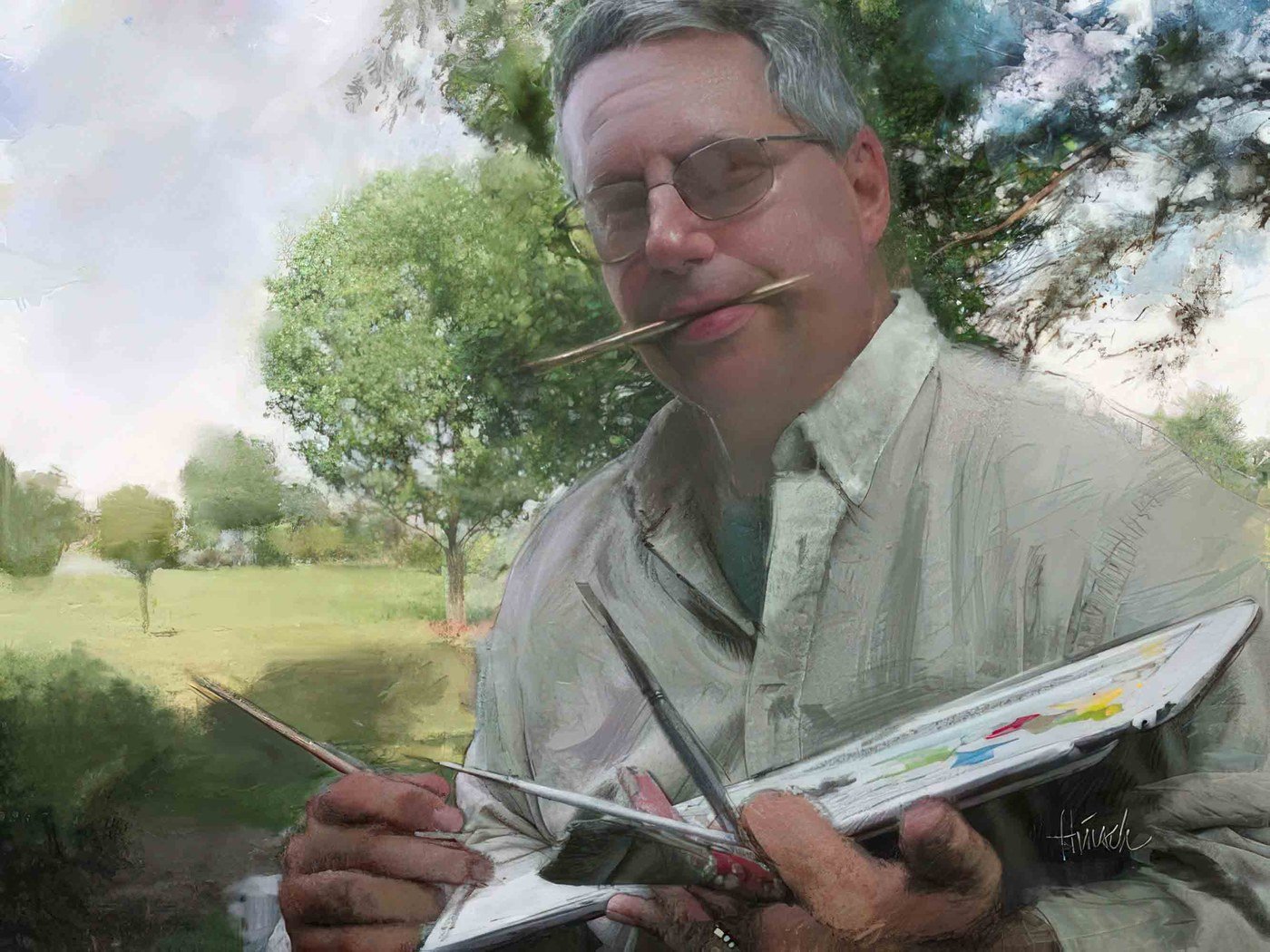
Self-portrait, William Dean Hinsch, 1986
Originally published in CityScene, July 1, 2024
A Conversation
On a five-decade career, AI as a tool rather than a threat, Norman Rockwell, and what makes a portrait more than a faithful likeness.
Self-portrait, William Dean Hinsch, 1986
Originally published in CityScene, July 1, 2024
You've had a long and varied career. When you look back, do you think it unfolded the way it should have?
Not exactly. I had a great deal of talent when I was young, and I knew it. But talent and a career are not the same thing.
I spent an enormous amount of time developing my abilities—learning to draw, paint, compose an image and, eventually, communicate complicated ideas visually. I was intensely interested in becoming better. What I didn't understand was how to market that ability, how to sell it, or even which markets I should be pursuing.
My professional life was also somewhat landlocked by geography. I was building a career in Toledo, Ohio—not New York, Chicago or Los Angeles. Today, the Internet makes geography almost irrelevant. It didn't then. Your opportunities were often defined by where you lived, whom you happened to meet and what you knew existed.
I made a career, certainly. I worked for The Toledo Blade, became an art director, co-founded Root Learning and helped invent the Learning Map. I have painted governors, corporate leaders, families and public figures. But there were markets I never knew how to reach—and, frankly, markets I didn't even know existed.
I was so busy learning to do the work that the business of creating a career largely went wanting.
Do you regret that?
I regret not understanding it sooner.
But a career is never a neat line. It is more like a river. It bends around whatever is in front of it. Sometimes it cuts a new channel; sometimes it gets trapped for years between the same banks.
The important thing is that I continued developing. I never stopped looking, thinking or trying to become better. At this point in my life, I probably have more ability, more understanding and more to say than I did at any earlier point.
So I don't see this as the winding down of something. I see it as finally bringing together everything I have learned.
You have worked as an illustrator, painter, designer, art director and business founder. What connects all of those things?
I solve problems visually.
That is the thread running through everything I have done. Sometimes the problem is how to capture a human being in a portrait. Sometimes it is how to take a complicated business strategy and make it understandable to thousands of employees. Sometimes it is how to tell an entire story in a single image.
Technique matters enormously, but technique is not the destination. It is the vehicle.
I'm not interested in making a painting merely to demonstrate that I can paint. I want the picture to do something. It should reveal character, preserve a memory, explain an idea, tell a story or create an emotional response that could not have been created quite the same way in words.
That brings us to artificial intelligence. Do you consider AI a threat to artists?
I see AI as a tool. It is not an end-all, be-all, and it certainly is not a substitute for having something to say.
The mortal enemy of every working professional artist is time. If you make your living from art, time is not an abstraction. Time determines how many ideas you can explore, how many assignments you can accept and whether you can afford to give a project the thought it deserves.
That is the number-one attraction of AI for me: it saves time during exploration.
I can now try ten different compositions in twenty minutes. I can experiment with lighting, tone, atmosphere, poses and even entirely different concepts. Then I act as a curator. I look at the results, recognize what has value, reject most of it and cobble together the useful pieces as a starting point.
From there, I develop the actual work of art in the old-fashioned way artists have worked for centuries: through judgment, drawing, revision, selection, elimination and craft.
AI can produce possibilities. It cannot decide which possibility belongs to me.
Some people would say that using technology diminishes the authenticity of the art.
That argument has appeared almost every time artists have encountered a new tool.
Vermeer is widely believed to have used the camera obscura. It was a new piece of optical technology that helped him see and paint in a way that served his particular vision. Was it cheating? Apparently not. His paintings are now worth untold millions, but more importantly, artists, critics, curators and institutions have agreed for centuries that the work has almost no equal.
The technology did not make Vermeer. Vermeer made Vermeer.
Later, illustrators adopted projectors, camera lucidas, photography and any number of optical and mechanical aids. Why? Partly because of the same problem artists still have today: time. Yet many of the works they produced are stunning.
Was the projector the artist? Of course not. It was a tool in the hands of an artist.
Artists have always glommed onto new tools when those tools could serve their vision. The real question is not, “What instrument did you use?” The question is, “What did you make with it, and is it any good?”
Norman Rockwell is an important example for you. Why?
Rockwell began his career in a fairly traditional way. He would pose models and sketch them from life, much as Howard Chandler Christy and other illustrators had done. But as photography became ubiquitous, Rockwell embraced it completely.
Eventually, he photographed and compared virtually every aspect of a proposed painting. In some ways, he operated more like a movie director than a painter. He chose the cast, designed the costumes, arranged the lighting, directed expressions, controlled gestures and staged the entire scene before painting it.
Yet Rockwell could paint like almost no other illustrator.
Why? Because in the end, he wasn't simply trying to be a painter. He was telling stories.
The paintings mattered because the stories mattered. His version of America became so persuasive that, for people of a certain generation, it helped create the mythological, nostalgic America they remember—whether that America ever existed exactly as he painted it or not.
Photography didn't rob Rockwell of his art. It gave him greater control over his storytelling.
So where do you draw the line with AI?
The line is authorship.
If I press a button, accept whatever comes out and call myself the artist, I haven't done very much. But if I conceive the idea, direct its development, make hundreds of judgments, combine and alter the results, draw and paint from them and bring the work into alignment with a vision that existed in my mind—then AI has served the same general role that photography, projectors and reference material have served for generations.
The technology is not the vision. It has no personal history, no taste, no intention and no reason for choosing one thing over another.
The artist supplies the why.
What makes a portrait more than a faithful likeness?
A likeness is only the beginning.
A passport photograph can establish what someone looks like. A portrait should suggest who that person is—or who that person became in the memory of the people who loved them.
That requires interpretation. The setting, posture, light, expression and objects surrounding the subject all contribute to the story. Sometimes what you leave out is as important as what you put in.
A good portrait should feel inevitable when it is finished. The viewer should think, “Yes, that is exactly how I know him,” even though no photograph ever captured precisely that moment.
You frequently work from imperfect, incomplete or unrelated photographs. Is that a limitation?
It can actually be the reason for making a painting.
Families rarely possess the perfect photograph. The mother is looking away. The father died before the grandchildren were born. The best expression is in one photograph and the right pose is in another. Sometimes the people we most want together were never photographed together at all. A painting allows those fragments to become a whole.
But the goal is not to create an obvious collage. The goal is to make the final image feel like a single truthful moment—one that may never have physically occurred, but expresses something emotionally true about the family.
That is one of the things painting can do that photography often cannot.
After so many years, what are you still trying to learn?
How to eliminate what isn't necessary.
Young artists often believe improvement means adding more—more detail, more technique, more finish. Eventually, you begin to understand that strength often comes from selection.
Which edge should disappear? Which detail is distracting? Which gesture tells the story? Where should the eye go first? What can be suggested instead of explained?
The longer I work, the less interested I am in proving how much I can do. I am more interested in identifying the one thing the picture must do—and making sure it does it.
What advice would you give a talented young artist today?
Develop your ability, certainly. There is no substitute for being good.
But don't assume that excellence will automatically find its market. Learn how the business works. Understand who needs what you do, where those people are and how to reach them. Do not wait forty years for someone else to explain the marketplace to you.
At the same time, don't chase every trend until you no longer know what belongs to you. Learn from everything, use every useful tool, but develop judgment. Taste is ultimately the ability to recognize what is good, what is false and what is yours.
Talent gives you possibilities. Judgment gives those possibilities direction.
How do you want people to understand your work now?
I want them to see that the work is not divided into unrelated chapters—illustration over here, portraiture over there, business visualization somewhere else.
It has all been one pursuit: using pictures to help people see something more clearly.
Sometimes that means seeing the character of a person. Sometimes it means seeing the structure of an idea. Sometimes it means seeing a family's history brought together in one place.
The tools have changed. The markets have changed. The speed at which we can explore an idea has changed enormously.
But the essential responsibility of the artist has not changed: to look harder than most people look, choose deliberately and make something that could not have existed without that particular human being behind it.
Start Your Commission
Whether it's a family gathered across generations, a beloved pet, or a tribute to someone no longer with us — every piece begins with a conversation.
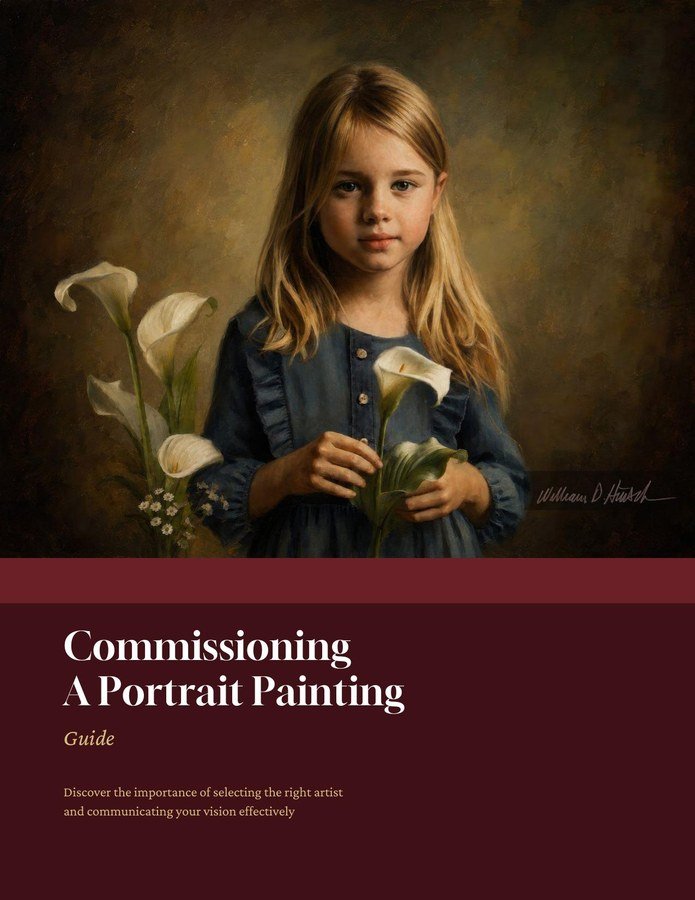
Free Guide
Learn how to choose the right artist and communicate your vision — delivered straight to your inbox.
We'll never share your email. Unsubscribe anytime.
Your free guide is on its way to your email. If you don't see it in a few minutes, check your spam folder.